
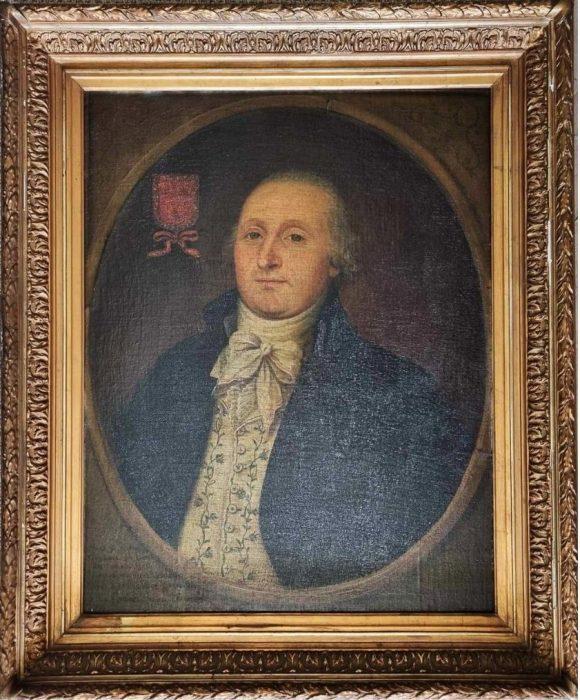
A fine portrait of Bon Albert Briois de Beaumetz ( 1755-1801?). He was a French nobleman who was heavily involved in the early years of the French Revolution as a prominent constitutional monarchist. He shifted from a reformer supporting early revolutionary ideals to a moderate trying to halt the rise of the Reign of Terror.
Born in Arras, Albert de Beaumetz was the son of an ardent royalist and a premier president of the Superior Council of Artois, a judiciary body of the ancien regime. In 1785, Beaumetz succeeded his father at the Council of Artois and became himself a distinguished personality. Leveraging his background as a magistrate, he actively shaped France’s new legal system. He published major foundational texts to reform criminal justice. He was the lover of Jeann Louise Henriette Genest Campan, a lady-in-waiting for Marie Antoinette.
In the local elections, Bon Albert de Beaumetz was elected as a member by the Second Estate of the Artois, while Maximilien Robespierre managed to get elected by the Third Estate. He tried in vain to put a brake on the rise of revolutionary violence. As the Revolution grew increasingly radical, Beaumetz used his position to try to curb the rising revolutionary violence and block early elements of the Terror, though his efforts ultimately proved ineffective
After the fall of the monarchy (10 August 1792), Beaumetz emigrated to Germany, England then the United States. He married the daughter of the first United States Secretary of War, Henry Know. He was naturalised as an American citizen. In May 1796, accompanied by his wife, he travelled to Calcutta where he disappeared from history after a last letter sent by him in March 1801.
The text ( added posthumously ) at the base of the portrait reads:
Left: Droit e Justice, Nous, amis, qui loin des batailles, Succombons dans l’obscurité, Vouons du moins nos funérailles, A la France, à la liberté
In English: Right and Justice, we, friends, who far from the battlefields, fall into obscurity, let us at least dedicate our funeral rites, to France and to liberty
Right: Droit e Glorie, Mourir pour la Patrie, C’est le sort le plus beau, le plus digne d’envie
In English: Right and Glory, to die for one’s country, is the fairest fate, the one most worthy of envy
Written in 1847 by Alexandre Dumas & Auguste Maquet ( co autors of The Count of Monte Cristo and The Three Musteteers), The Chant of the Girondins was the national anthem from 1848 – 1852. The lines of the refrain were borrowed from the 1792 song Roland à Roncevaux by Claude-Joseph Rouget de Lisle, famously known as the author of the French national anthem, La Marseillaise.
H 710mm, W 550mm
$4,200.00